

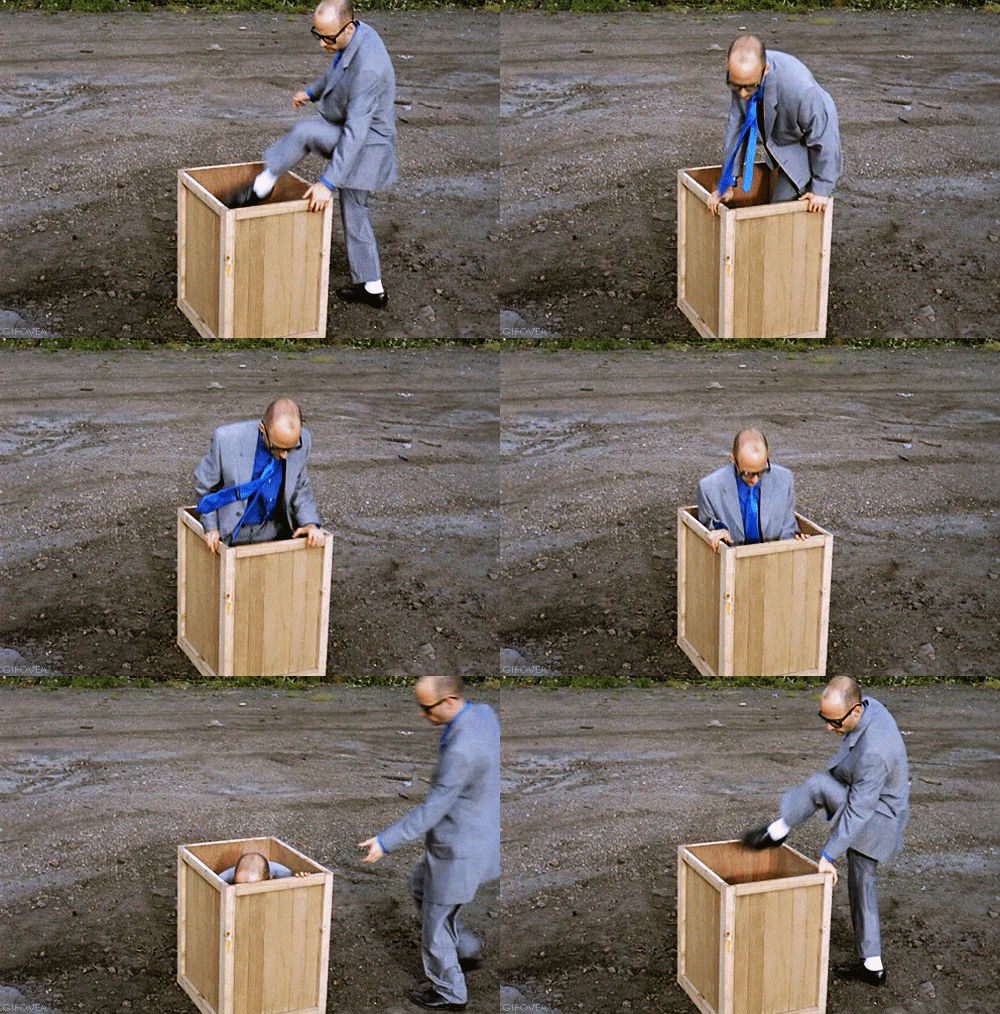
While working together for a project or pitching a new idea, the most common sentiment felt across the room is the need to ‘think outside the box’. This means to think from a different perspective and to challenge convention. What exactly is this box, and why the obsession over escaping it? While I agree that the adoption of unique, “beyond the textbook” methods in solving problems is important, I do not see eye to eye with those who associate creativity and uniqueness solely to this vast space outside the box where imagination supposedly flows effortlessly. Thinking within the “box” you’ve been provided with can also be accomplished creatively. When we ask people to expand their thinking capabilities outside the box and come up with original and innovative solutions, we subconsciously separate the territory for the ‘ordinary’ and ‘weak’ ideas from the ‘commendable’ and ‘extraordinary’. The former describes the ideas which are disregarded and shunned simply for being too simple and unimaginative. No good comes from forcing everyone to over-emphasize creativity over practicality.
When well-defined constraints are set, it is easier to make decisions. Consider that I task you with writing about who you aspire to be in the future. This question is vague, and it evokes an endless number of ideas waiting to be constructed into meaningful sentences. However, if I ask you to answer the same question in just five words, you now have bounds within which you must formulate your thoughts, and hence a ‘box’ is created. In such a situation the box limits your degree of freedom. I believe that this restriction leads to deeper and more meaningful ideas. Thinking within the box means to fully explore the depths of a subject within the constraints defined by the box; it means restricting your resources, but not how you utilize them. Additionally, many find that they are not the best at developing solutions from a vast array of unstructured options. They are rather dependent on the pressure and thrill that deadlines, target charts, and constraints provide, in order to maximize productivity and achieve the end objective. Recently, an experiment was conducted in which the manager of a leading organization asked his employees to come up with effective plans and strategies for development. He provided only four small boxes for the employees to list their ideas. Interpreting the results of the experiment, he concluded that limiting the space provided for sharing ideas leads to the proposal of effective solutions that can be tested immediately. Put simply, thinking within imposed boundaries forces one to think more deeply and results in the creative utilization of limited resources. Don’t get me wrong; thinking outside the box does bring novel ideas and opinions, but it is effective only if there are strict parameters within which individuals can work. The box provides a framework, acting as the foundation which brings you a step closer to your objective. The walls of the box are made up of deadlines and goals, but they can also be a source of motivation. An open box would mean an endless search or a never-ending quest, whereas one that is closed represents a world of opportunities where there is a beginning and an end.
In conclusion, creative constraints are an opportunity in disguise. A limitation that we see as an obstacle can also be perceived as an opportunity to optimize our performance. Everything surrounding us can be considered a box- work, relationships, and even our lives. They consist of ‘walls’ that influence our way of living. Sometimes, the best way to solve a problem is to choose your own box and customize it according to your priorities; the sky’s the limit (or is it the lid? Sorry, this analogy is getting confusing). Your life is not limited to a closed structure; build one when the need arises, and then break free!

 Views, Wo